
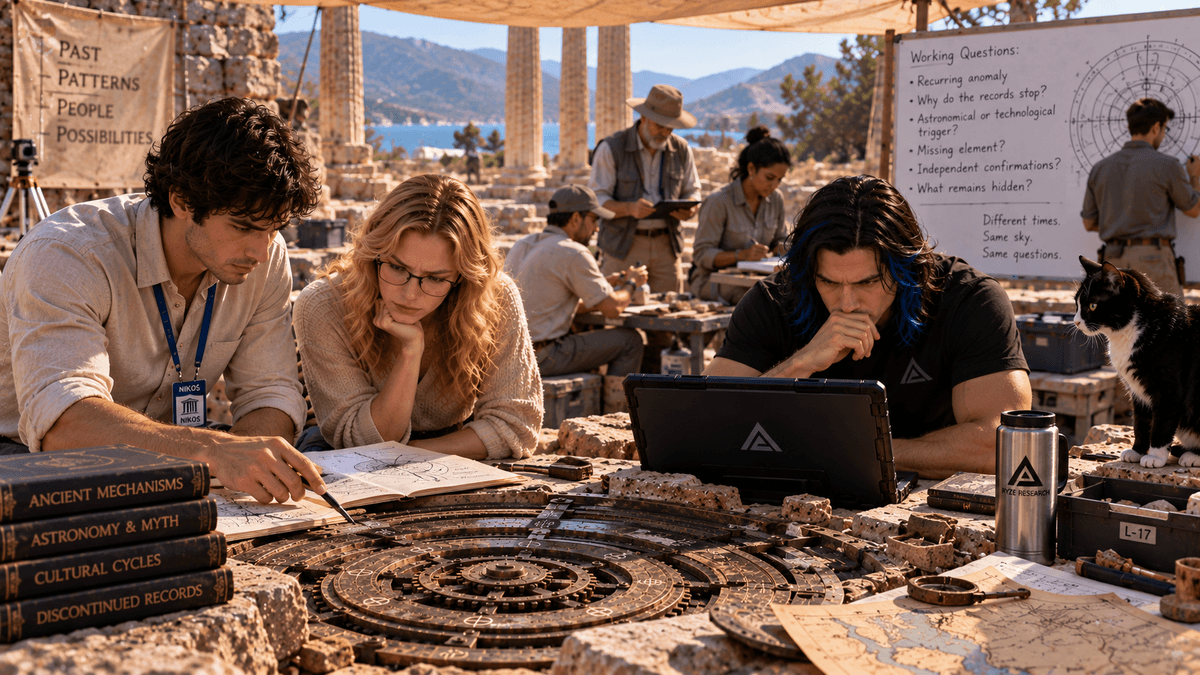
Archaeology teaches patience.
People imagine discovery as a dramatic moment—the brush moves aside, something ancient appears, and suddenly history changes.
Usually, it is dirt.
More dirt.
A stone that looked interesting until you cleaned it.
And paperwork. There is always paperwork.
But lately, patience has become more difficult.
The instruments are behaving strangely. Measurements don't always agree. Reports from outside Rhodes describe disruptions that should have nothing to do with an archaeological site, yet somehow they feel connected to what we're seeing here.
Then Ryze, Shyne and Luma returned.
I was glad to see them.
I was also concerned that they had come back at all.
Ryze asks questions differently now. He still searches for evidence, but I've noticed moments when even he seems uncertain what the evidence means.
Shyne watches the mechanism.
The mechanism does nothing. It clicks randomly—or so it seems. Sometimes it begins to spin, then stops.
And somehow, that is becoming more unsettling than if it simply remained still.
We keep working.
We document. We compare. We uncover one small piece of the past at a time while the world around us becomes increasingly difficult to explain.
Perhaps that is why I almost missed it.
Late in the day, beneath material we had passed dozens of times, something caught my attention.
At first I thought it was another fragment.
Then I cleared a little more away.
And stopped.
Archaeology teaches patience.
It also teaches you to recognize the moment when patience has finally been rewarded.
I think we have been looking in the wrong place.
— Nikos